News
With So Much Land Supply, Can Property Prices Still Rise?
More Land, More Stability? How the GLS Programme is Anchoring and Cooling Singapore's Private Home Market
In recent years, price growth in Singapore's private residential market has continued to moderate.
Yet many may have overlooked a crucial fact: this is not due to a tightening of land supply, but quite the opposite—it is driven by a steady increase in land supply.
Since 2022, the government has progressively expanded private residential land supply through the Government Land Sales (GLS) programme, establishing a clear and predictable future supply pipeline. This calibrated and sizeable land release strategy is helping the private housing market transition from post-pandemic rapid gains into a more balanced and sustainable phase.

From 2022 to 2025: Expanding Land Supply, Moderating Price Growth
Data shows that between 2022 and 2025, across each half-yearly GLS programme, the number of private residential units across both the Confirmed and Reserve Lists charted a clear upward trend.
Concurrently, annual private home price growth has moderated year after year:
2022: Up 8.6% for the full year (the strongest post-pandemic rebound)
2023: Growth eased to 6.8%
2024: Further moderated to 3.9%
2025: Dipped further to 3.4%, the lowest pace since 2020
According to the latest flash estimates, private residential prices rose by just 0.7% quarter-on-quarter in Q4 2025, easing from 0.9% in Q3 and reflecting the continued cooling of price momentum.
This trend demonstrates that slowing price growth is not caused by disappearing demand, but by greater clarity over future supply.
Not a Land Shortage, but Visible Supply
A pivotal takeaway is that this round of price moderation has occurred against a backdrop of continuous land supply expansion, rather than land scarcity.
The sustained expansion of the GLS programme has significantly enhanced the visibility of upcoming new launches. This allows both buyers and developers to form stable expectations, reducing the likelihood of prices being driven up by scarcity anxiety.
In other words, the market is not entering a structural supply crunch, but is instead shifting towards a healthier supply-demand equilibrium.
1H 2026 GLS: Supply Remains High, Not Tightening
Under the 1H 2026 GLS programme, the Confirmed List alone can yield approximately 4,575 private residential units—more than 50% above the 10-year historical average.
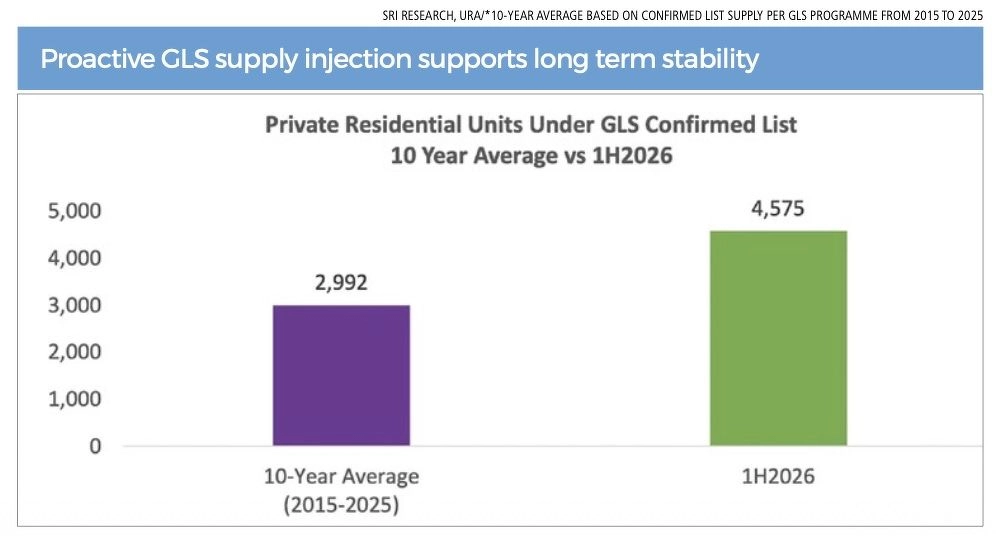
While this figure is slightly lower than the 4,725 units in 2H 2025, it remains distinctly high from a historical perspective. This does not signal a policy shift towards tightening, but rather a calibrated fine-tuning of land release pacing.
It reflects the government's clear stance: maintaining stable long-term land supply to prevent supply crunches from pushing up home prices.
Fewer Choices? Driven by Developer Pacing, Not Land Scarcity
At times, buyers might feel there are fewer new launches available, but this does not equate to a shortage of land.
In reality, developers in the current environment are paying closer attention to launch pacing and sales absorption rates, rather than rolling out projects en masse.
This reflects a more mature, disciplined development strategy rather than constrained supply.
Market data supports this view:
In 2025, around 11,430 new units were launched, marking one of the highest volumes since 2013.

Most of these projects stem from GLS sites awarded over the preceding years (2023–2024), demonstrating that land sales policies are steadily and effectively translating into tangible market supply.
2026 Outlook: Outside Central Region (OCR) to Anchor the Market
Looking ahead to 2026, new launch supply is projected at around 13,560 units, comprising:
OCR (Outside Central Region): ~64.9%
RCR (Rest of Central Region): ~22.2%
CCR (Core Central Region): ~12.9%

This indicates that the 2026 new launch pipeline will continue to be dominated by the OCR, with core support stemming from HDB upgraders and owner-occupier demand.
As several major OCR projects enter the market, coupled with a progressively improving interest rate environment, the market is expected to sustain a trajectory of steady volume and gentle price growth.
Moderation, Not Deterioration
Overall, Singapore's private residential market is not running hot; instead, it is transitioning into a more rational and orderly phase.
The steady pipeline of land releases provides a firm anchor for market stability.
Taking various forecasts into account, private residential prices are expected to rise by around 2.5% to 4.0% in 2026—a moderate, sustainable growth range.