News
New, Pricey, and Prime: Can These Properties Still Lose Money?
A Look at Last Year's Least Profitable Condos: What Lessons Can We Learn?
Many believe that a prime location, a newer project, and a core district are a surefire recipe for guaranteed gains.
However, the 2025 resale market proved once again that a condo's profitability is never determined by a single factor alone.
What truly drives profit and loss is a multifaceted "profit matrix" shaped by location, remaining lease tenure, surrounding amenities, and the profile of demand.
Several resale transactions from last year served as an expensive lesson for the market.

The Overall Market Rose, but Unprofitable Deals Persisted
Looking at broader market data, islandwide condo resale prices continued an upward trajectory in 2025, with average transaction prices rising by around 4.2% year-on-year to $1,778 psf.
Nonetheless, this pace of growth was more moderate compared to the approximately 5% year-on-year rise recorded in 2024.

Urban Redevelopment Authority (URA) private residential property price index figures mirrored this trend, climbing roughly 3.4% year-on-year in 2025, down slightly from 3.9% in 2024.
Against the backdrop of an overall market uptrend, numerous "loss-making" sales still took place. These unprofitable transactions offer invaluable lessons for buyers and sellers alike.
Lesson 1: A Prime Location Does Not Guarantee Profits
An analysis of unprofitable transactions concluded in 2025 revealed that seven condo developments each logged 10 or more loss-making deals over the course of the year.
Most of these developments are situated in traditional prime luxury enclaves like District 1 and District 9, and all sit squarely within the Central Area.
This underscores a harsh yet unmistakable reality: "A prime location ≠ guaranteed profits."

Located in District 1, Marina One Residences recorded the highest number of unprofitable transactions in 2025, chalking up 30 loss-making deals. One of these transactions saw a staggering loss of roughly $1.15 million.
The unit fetched a transacted price notably below the development's historical average, and average prices at the project have experienced a cumulative decline of roughly 19.9% between 2018 and 2025.

A similar picture emerged at OUE Twin Peaks in District 9.
In 2025, the number of loss-making transactions at this project actually exceeded profitable ones, with one sale racking up a loss in excess of $1 million.
Looking at long-term price trends, the development's average transaction price has declined by more than 15% since 2016.

These cases show that even in core locations, buying at an inflated price or contending with shifting buyer demand will relentlessly erode profit margins.
Lesson 2: Newer Condos Can Also Lose Money
Another common misconception is: "As long as the development is newer and has a long balance lease, it is safe."
Yet data shows that among the seven developments with a high volume of loss-making transactions last year, all were under 20 years old, with remaining leases of at least 75 years.
The youngest of the pack was Sophia Hills, which only obtained its TOP in 2018 and has roughly 86 years of lease remaining.

Despite this, the project recorded 11 unprofitable transactions in 2025, with losses spanning from approximately $11,000 to $245,000.
The steepest loss stemmed from a ground-floor one-bedroom unit. Purchased at a peak price in 2018, its resale price in 2025 suffered a notable correction, culminating in a loss of nearly $250,000.
This demonstrates that a younger age is by no means an insurance policy against capital risk.
Lesson 3: Schools and Shopping Malls Matter Immensely
Among all the developments with high loss rates, Marina One Residences and Reflections at Keppel Bay were particularly notable, with each logging more than 20 unprofitable transactions.
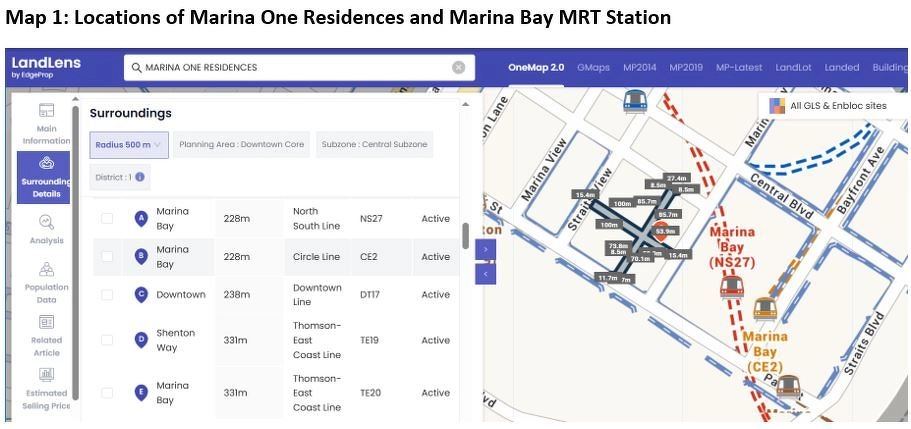
From a transport standpoint, both developments boast strong connectivity, situated close to MRT stations with excellent accessibility.
The Achilles' heel, however, lies in their day-to-day living amenities.
While Marina One Residences is well-served by MRT lines and expressways, there are zero schools within a 1km radius, and only a single primary school within 2km.
Reflections at Keppel Bay similarly lacks surrounding school options, and the nearest major shopping mall sits over 1km away.

Consequently, Reflections at Keppel Bay recorded 29 loss-making sales in 2025, including three transactions that incurred losses north of a million dollars.
The biggest loss reached approximately $1.38 million on a three-bedroom unit, which transacted far below the development's average pricing that year.

This reaffirms that while MRT links solve the daily commute, they cannot fully make up for a shortfall in everyday lifestyle conveniences.
Lesson 4: Sentosa Condos Still Face Soft Demand
In the 2025 resale market, a total of 40 projects registered zero profitable transactions while logging at least one loss-making deal.
Among these, three projects posted individual transaction losses exceeding $3 million—two of which are located in Sentosa.

The headwinds facing Sentosa are well-documented: no schools, no MRT stations, and commercial amenities tailored largely to hospitality and tourism.
The most eye-watering loss occurred at Marina Collection.
A four-bedroom-plus-study unit bought at a high point in 2008 transacted in 2025 at a price well beneath its original purchase price, translating to a hefty loss of around $3.675 million.
In terms of broader price trends, the drop in average transacted prices for this development was also considerably steeper than for other 99-year leasehold projects on Sentosa.
What Can Buyers and Sellers Take Away?
Real estate transactions inevitably involve personal variables and preferences. Paying a premium to live closer to family, enjoy familiar surroundings, or satisfy personal lifestyle desires is neither inherently right nor wrong.
However, examining last year's loss-making transactions reveals several clear common threads: prime locations do not automatically guarantee strong demand; newer projects are not immune to price corrections; everyday amenities like schools and malls are critical for family-oriented buyers; and buying above market averages or selling below them remains the single biggest driver of financial loss.