News
From BTO to Condo: Is Singapore’s Traditional Asset Progression Pathway Changing?
Are HDB and Private Homes Decoupling? Is Property Upgrading Becoming Harder in Singapore?
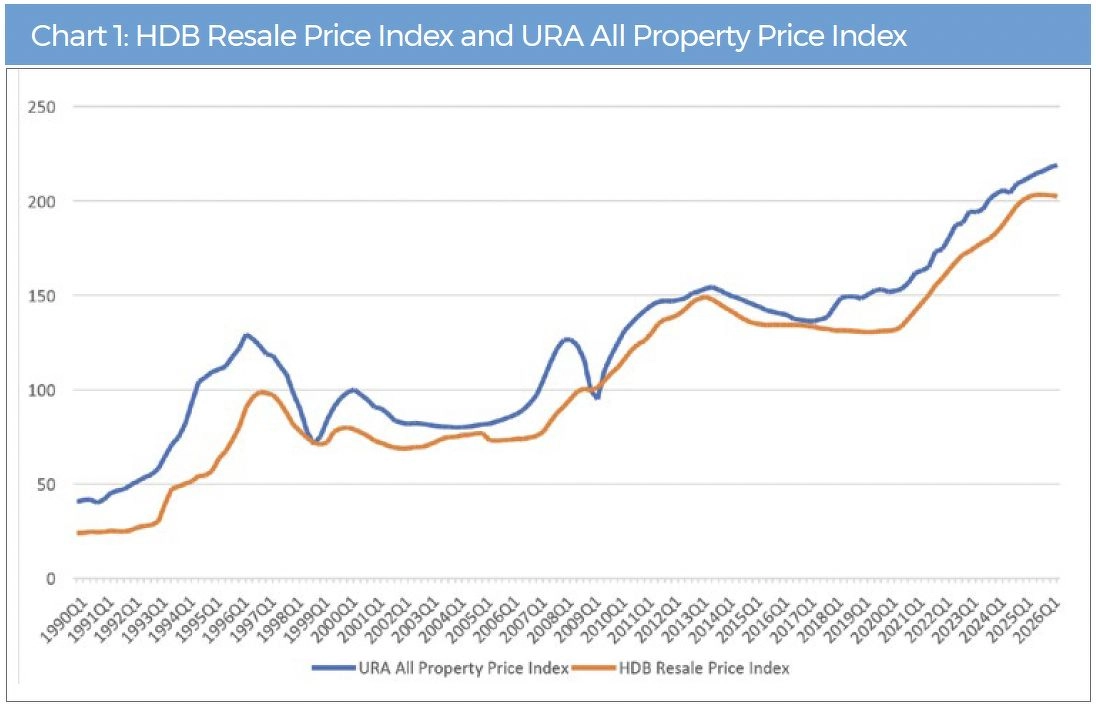
In the second quarter of 2026, a noteworthy divergence emerged in Singapore's housing market: while private residential prices continued their upward climb, HDB resale prices softened for the third consecutive quarter.
As of Q2 2026, the HDB Resale Price Index sat 0.4% below its peak in Q3 2025.
Yet over the same period, private residential prices rose by 2.0%.
This begs an important question: Are the HDB and private residential markets beginning to decouple?
If the price gap between the two continues to widen, the hurdle for HDB households looking to upgrade to private condominiums may grow increasingly daunting.
Why Does the Price Gap Between HDB and Private Property Matter?
Historically, the HDB and private residential markets have always been closely intertwined.
For many Singaporean households, the conventional housing progression route has long been: BTO → HDB Resale → EC / Private Condominium.
When homeowners sell their HDB flats, the sale proceeds and accumulated home equity serve as primary funding for their next private property purchase. Consequently, the stronger HDB prices perform, the greater the equity built, giving owners greater financial buffer and confidence to upgrade.
Conversely, if HDB price growth moderates while private properties continue to appreciate, the expanding price divide means HDB owners must bridge a much wider funding shortfall.
Furthermore, HDB owners represent a cornerstone buyer pool for private homes.
In 2025, 77.2% of resident households in Singapore lived in HDB flats, with an owner-occupancy rate of 92.3%. Hence, any dent in HDB upgraders' purchasing power can ripple through and reshape overall demand in the private housing market.
We Have Seen Similar Divergence Before
However, this is not the first time HDB and private home price trajectories have diverged. In the previous property cycle, private home prices bottomed out in Q2 2017 before rebounding, whereas HDB resale prices only halted their downward trend in Q2 2019.
In other words, the two segments moved out of sync for nearly two full years back then.
Between 2017 and 2019, private residential buyers with HDB addresses fell from 11,798 to 7,997.
At first glance, this might suggest that a widening price gap made it harder for HDB owners to upgrade. But a closer look at the data paints a more nuanced picture.
The Proportion of HDB Upgraders Remained Remarkably Resilient
In July 2018, the Singapore Government raised Additional Buyer's Stamp Duty (ABSD) rates on Singapore Citizens purchasing their second and subsequent residential properties.
This cooling measure targeted property count rather than whether buyers resided in public or private housing.
As a result, transaction volumes across the entire private residential market—including Executive Condominiums (ECs)—contracted in 2018 and 2019.
Yet notably, from 2017 to 2019, HDB upgraders consistently made up about 40% of all private home buyers.
Breaking this down further into new sales and resale segments reveals similar stability.
During that period, around 46% of buyers in the new private home market held HDB addresses, while in the resale and sub-sale market, the share stood at approximately 35%.
Thus, the previous price divergence between HDB and private homes did not fundamentally alter the overall buyer demographic profile.
ECs Emerged as the Preferred Bridge for HDB Upgraders
The clearest beneficiary of this dynamic was the Executive Condominium (EC) segment.
In 2017, HDB upgraders accounted for approximately 61.9% of EC buyers.
By 2019, this share had surged to 72.1%.
Looking exclusively at new EC launches, the shift was even more pronounced.
In 2018, HDB upgraders made up 66.4% of new EC buyers.
By 2019, that figure had climbed to nearly 85%.
A key catalyst was the government's revision of the monthly household income ceiling for new EC buyers in 2019 from S$14,000 to S$16,000, broadening eligibility to more aspiring upgraders.
In contrast, the proportion of HDB upgraders buying resale ECs held relatively steady at around 60%.
This underscores how ECs serve as a vital stepping stone whenever the leap to private condominiums steepens.
Landed Properties Remain the Highest Mountain to Climb
Disaggregating by property type reveals stark differences in the feasibility of upgrading for HDB owners.
Between 2017 and 2019, buyers with HDB addresses accounted for only around 20% of landed home purchases.
The reason is straightforward: quantum.
Landed homes command significantly higher absolute price tags compared to standard private condos and ECs, placing them out of reach for the vast majority of HDB upgraders.
By 2026, this divide has widened considerably further.

Why 2026 Differs from the Previous Cycle
While divergence has happened before, today's market fundamentals differ substantially—most notably in cumulative price growth over the past decade.
From early 2016 through the first half of 2026, private residential prices climbed by a cumulative 59.9%, compared to a 50.7% gain in HDB resale prices. Both appreciated substantially, but private property outpaced public housing.
Over time, this compounding disparity means the financial gap HDB owners must bridge upon cashing out has expanded noticeably.
Leaping from HDB to Landed Is Increasingly Unattainable
This shift is most acute in the landed housing segment.
In the first half of 2026, HDB upgraders accounted for just 3.1% of new landed home purchasers.
This represents the lowest level on record.
Today, a new 99-year leasehold terrace house easily commands upwards of S$4 million.
Even if an owner disposes of a million-dollar HDB flat, bridging the jump to a S$4 million-plus landed property leaves a massive capital deficit.
Barring intergenerational wealth pooling or co-investing with family, this leap has become virtually unattainable for most HDB households.
Aiming for the CCR? Buyers Are Trading Space for Location
Compared to landed properties, the share of HDB upgraders entering the Core Central Region (CCR) private condo market has also slipped, albeit less drastically.
However, the data reveals an intriguing trend: buyers are compromising on unit size to secure prime locations.
In 2016, the average size of a new non-landed CCR private home purchased by an HDB upgrader was around 79.8 sq m (859 sq ft). By 1H 2026, this contracted to 68.1 sq m (733 sq ft)—a drop of roughly 126 sq ft over a decade.
For families aspiring to own a prime CCR address, "upgrading" no longer strictly translates to a larger home. In many instances, it means downsizing from a spacious HDB flat into a more compact, centrally located private apartment.
A Marked Drop in HDB Upgraders Across the RCR and OCR
An even more telling shift has taken place in the Rest of Central Region (RCR) and Outside Central Region (OCR)—the traditional hunting grounds for HDB upgraders.
In 2016, HDB upgraders accounted for roughly 50% of new private home purchases in the RCR and OCR. By 1H 2026, that figure had plummeted to around 20%. The driving factor is, undoubtedly, affordability.
Since 2016, prices of new non-landed private residential units in the RCR and OCR have more than doubled.
Over the same period, resale prices of 4-room and larger HDB flats rose by just over 50%. While HDB properties appreciated commendably, target private condominiums outpaced them by a wide margin.
For aspiring upgraders, the cash and loan gap required has widened significantly.
The 20% ABSD Adds to Upgrading Friction
Beyond purchase prices, Additional Buyer's Stamp Duty (ABSD) heavily influences upgrading decisions. Currently, Singapore Citizens purchasing a second residential property face a 20% ABSD rate.
Consequently, HDB owners who prefer to buy their private home first before offloading their existing flat encounter substantial upfront capital and liquidity hurdles.
With private home prices rising, this steep cash outlay inevitably curbs many upgrading plans.
Why Have HDB Prices Softened in 2026?
Another pertinent question is why HDB resale prices have begun to moderate.
Since 2021, Singapore has steadily ramped up BTO supply. As more new flats hit the market, resale demand—which had swelled during pandemic-era supply crunches—has begun to normalize.
This increased public housing inventory is a key reason behind the easing price pressure in the resale market.
However, recent policy shifts could offer fresh support to the resale sector. The government has lifted the 15-month wait-out period for private property owners looking to buy non-subsidised HDB resale flats. Eligible private property downgraders can now enter the resale market immediately, potentially injecting renewed demand.
It is therefore premature to conclude that HDB resale prices will remain on a sustained downward trajectory.
Is Upward Housing Mobility Still Sustainable?
Beyond short-term price fluctuations, the broader question centers on Singaporeans' upward housing mobility.
Data shows that since 2016, the overall share of HDB upgraders among private residential buyers has trended downward.
Yet this also reflects structural shifts in Singapore’s household distribution.
In 1995, 95.4% of resident households lived in HDB flats, with only 4.6% in private homes.
Today, the landscape is markedly different. As household wealth has grown, the proportion of resident households living in private housing has increased to 17.9%.

In other words, a growing segment of buyers already reside in private property.
Thus, the declining proportion of HDB upgraders in the private market cannot be solely attributed to upgrading becoming "too difficult"—it is partly an organic outcome of evolving housing demographics.
ECs Set to Solidify Their Role as the Critical Stepping Stone
Should the gap between HDB flats and private condominiums widen further, ECs will play an even more indispensable role. By design, ECs bridge public and private housing, and recent policy enhancements reinforce this positioning.
The quota for first-timer families in new EC launches was raised from 70% to 90%, while the monthly household income ceiling for new EC purchases was increased from S$16,000 to S$18,000.
This expands eligibility to higher-earning sandwich-class households who find private condos financially stretched. Amid escalating private home prices, ECs will likely serve as the go-to wealth-building vehicle for ambitious HDB owners.
Standard, Plus, or Prime BTO? Your Choice Shapes Future Upgrading Paths
For young couples embarking on their first home purchase, the calculus extends well beyond "which BTO project looks best."
The BTO classification framework (Standard, Plus, Prime) directly impacts future upgrading trajectories. Plus and Prime flats come with a 10-year Minimum Occupation Period (MOP), meaning owners must wait twice as long before they can sell and upgrade.
Moreover, future buyers of resale Plus and Prime flats will be subject to prevailing BTO income ceilings (currently capped at S$16,000), potentially curtailing future resale buyer pools and upside.
In contrast, for buyers whose ultimate goal is to upgrade to private property promptly after fulfilling their 5-year MOP, Standard BTO flats offer significantly greater flexibility and liquidity.
Conclusion: Not a Complete Decoupling, but the Upgrading Threshold Has Shifted
The market data in 2026 presents a compelling trend: HDB resale prices have softened for three quarters in a row, while private home prices push ahead.
Yet historical precedent suggests this is insufficient evidence of a permanent structural decoupling between the two segments.
A similar gap played out between 2017 and 2019 without substantially eroding HDB upgraders' market share. The real point of concern lies in the cumulative price divergence built over the past decade.
Between 2016 and 1H 2026, private residential prices gained 59.9% versus 50.7% for HDB resale flats, while new private launches in the RCR and OCR more than doubled in price.
Hence, the classic BTO → HDB Resale → Private Condo ladder remains intact, but navigating it demands sharper financial planning and prudent strategy.
With Plus and Prime BTO flats locking owners in for a 10-year MOP while private condo prices advance, initial housing decisions can profoundly determine one's upgrading headroom a decade later.
Concurrently, with the EC income ceiling raised to S$18,000 and the first-timer quota increased to 90%, Executive Condominiums are set to become an even more indispensable vehicle for home upgrading.
Ultimately, rather than asking whether HDB and private homes have truly decoupled, the more practical question is: as the price divide widens, what is the smartest pathway for Singaporean households to chart their next property upgrade?