News
Buying a New Home vs Waiting for Interest Rates to Drop — Which is Smarter?
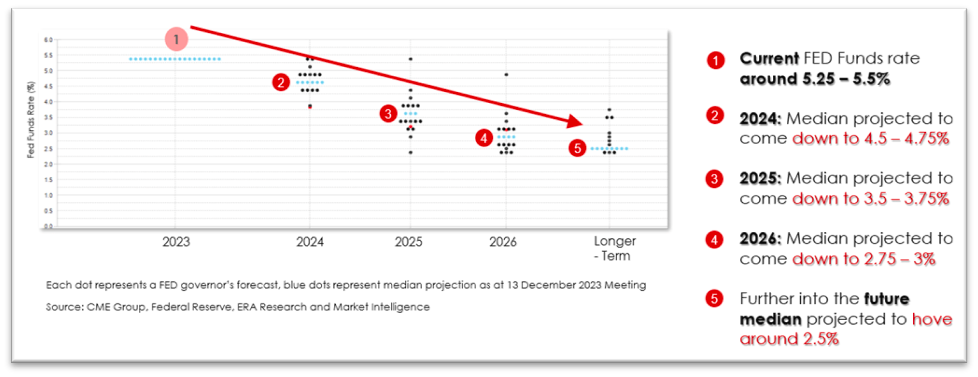
Source: CME, Federal Reserve, ERA Research and Market Intelligence
Following a series of interest rate hikes between 2022 and 2023 to combat inflation, the Federal Reserve may soon ease its monetary tightening measures.
According to a poll of economists, the Fed is expected to cut interest rates in the second half of 2024. As most floating-rate mortgage packages are pegged to the Singapore Overnight Rate Average (SORA), which in turn tracks movements in the Fed rate, rate cuts will likely lead to lower interest rates.
In 2024, the median interest rate is projected to fall from the current 5.25% - 5.5% to 4.5% - 4.75%. This range is expected to decline further in the medium term to 3.5% - 3.75% in 2025 and 2.75% - 3% in 2026, before stabilising at around 2.5%.
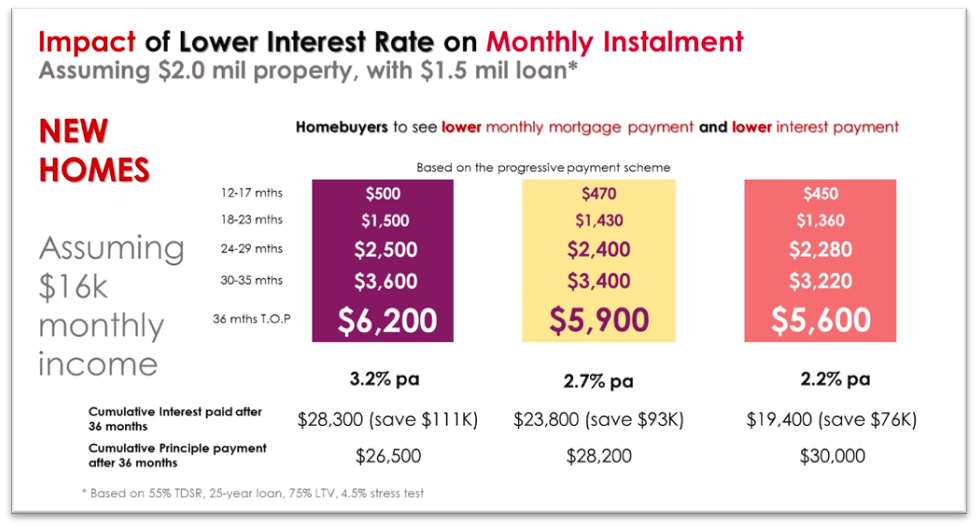
Source: ERA Research and Market Intelligence
The natural outcome of the Fed reversing its aggressive rate hikes is lower borrowing costs, which will certainly cheer homebuyers in Singapore as it brings about lower monthly mortgage instalments and interest payments.
Under the Progressive Payment Scheme, assuming a couple with a monthly household income of $16,000 takes up a $1.5 million loan to purchase a $2 million property, their monthly mortgage repayment would be $6,200 at an interest rate of 3.2% per annum. By comparison, if the mortgage rate drops to 2.2%, they would pay $5,600 per month—saving $600 each month.
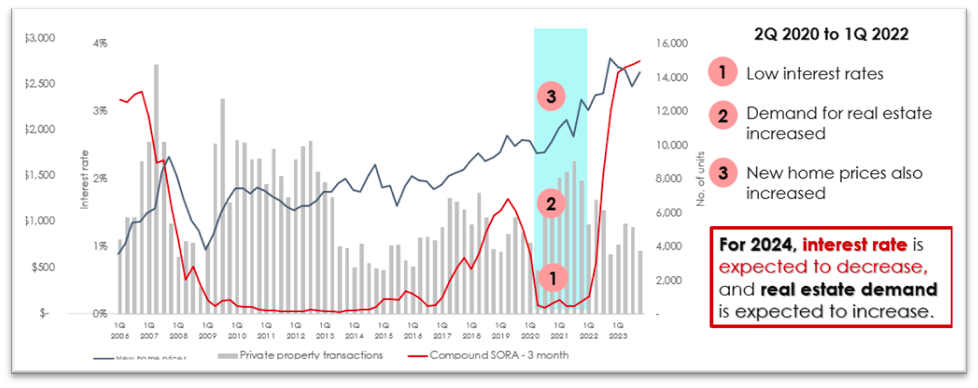
Source: MAS, URA, ERA Research and Market Intelligence (Interest rates are based on the last day of each quarter. Private residential property transactions include landed, non-landed, and EC transactions, but exclude en bloc sales)
Nevertheless, while falling interest rates offer clear benefits, homebuyers perhaps should not wait on the sidelines for too long before making a move.
If past market cycles are any indication, we can expect lower interest rates to be accompanied by an increase in local property demand, consequently driving up prices of new homes.
When the compounded 3-month SORA began declining in 2019, it triggered a market rebound between 2020 and 2022, leading to a surge in demand for new homes. More importantly, this led to a significant run-up in home prices. From 2Q2020 to 1Q2022, the average PSF price of new homes rose by 25.7%, climbing from $1,726 to $2,171.
Therefore, given the likelihood that history could repeat itself, buying a property now might be a wiser decision than delaying the purchase.
Disclaimer
This information is provided in good faith and does not relieve any party of the responsibility to verify information from relevant sources and/or seek appropriate advice from relevant professionals, such as valuers, financial advisers, bankers, and legal counsel.
For the avoidance of doubt, no responsibility or liability is accepted for the accuracy, reliability, and/or completeness of the information provided above.