News
Rising Salaries and Parental Support: More Young Singaporeans Buying New Private Homes

Singaporean buyers of new private residential properties are getting increasingly younger, with the median buyer age dropping from 45 in 2015 to 39 last year. Notably, the proportion of young buyers aged between 26 and 35 was nearly four times that of 2015.
Report data shows that the proportion of local buyers of new private homes aged between 26 and 35 surged significantly from 9% in 2015 to 35% last year.
Covering data from 37,000 Singaporean buyers of new private residential properties, the study found a clear trend towards younger purchasers. Nevertheless, the 36-to-45 age group remained the largest local buyer segment for new private homes, accounting for 37% of transactions.
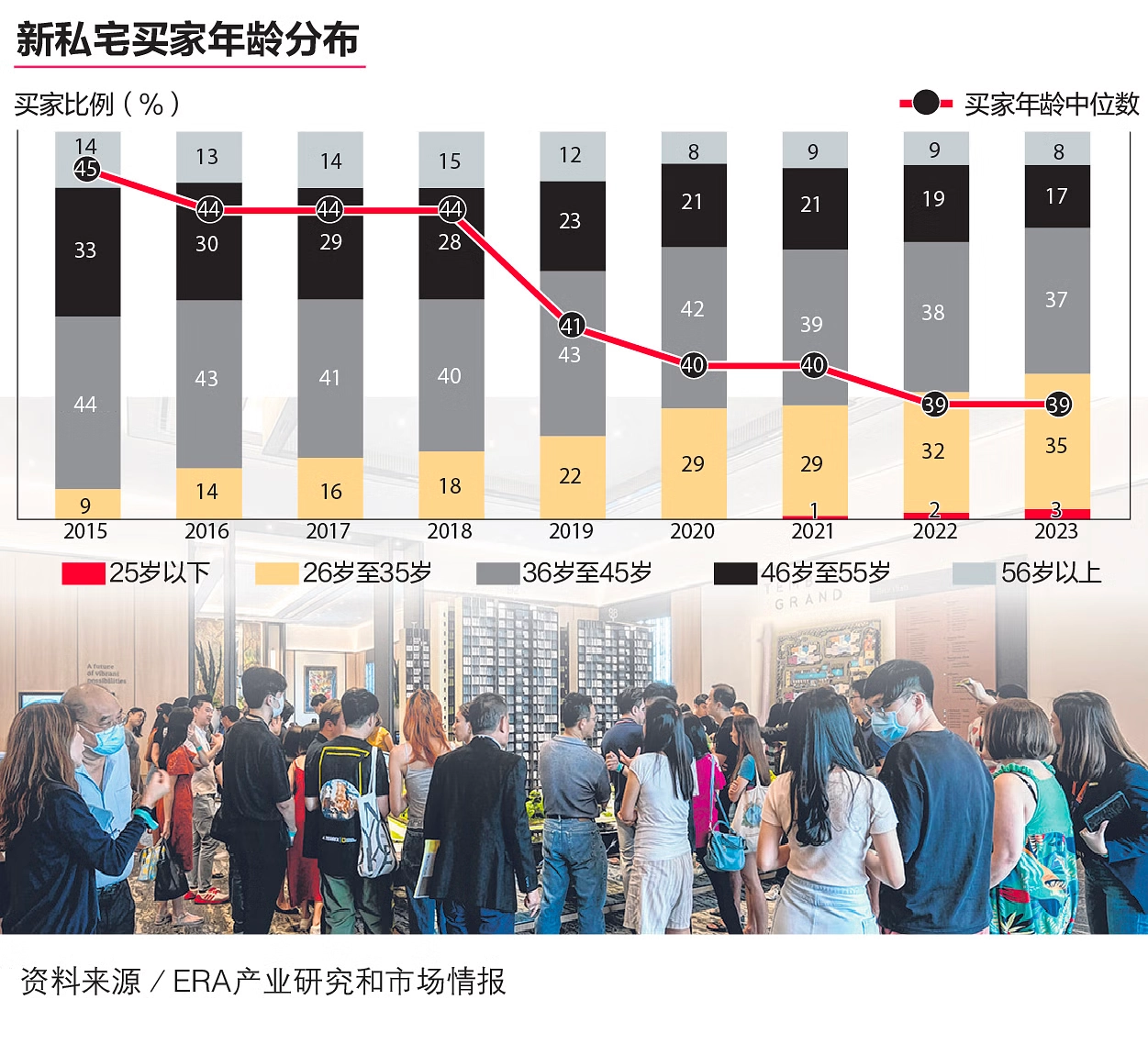
Between 2021 and 2023, amid an overall decline in private home sales, the number of new private home units purchased by young buyers fell by 59.5% from 1,818 to 737 units. However, this remained the smallest drop across all age demographics. Local buyers aged 36 to 45, 46 to 55, and 56 and above experienced steeper declines of 69%, 72.9%, and 71.8% respectively, underscoring the relative resilience of young buyers' purchasing power.
Rising salaries in recent years have helped younger buyers realise their aspirations of private homeownership. Citing data from the Ministry of Manpower (MOM), the report noted that full-time employed residents aged 25 to 34 saw salary growth of 15.8% to 16.9% between 2016 and 2022, while those aged 35 to 54 enjoyed growth of 19.8% to 53.8% over the same period. The prospect of future income growth has likely bolstered young buyers' confidence in investing in private residential property.
An increasing number of young individuals in their 20s and 30s make private homes their first choice once they have reviewed their financial standing and confirmed affordability.
Compared to over a decade ago, a wealth of property-related information is now readily available to help young buyers make informed decisions. This allows them to better appreciate the differences and capital appreciation potential among various housing types, prompting many to establish clear entry and exit strategies beforehand.
Another key factor is that private residential price growth has significantly outpaced that of HDB flats in recent years, while transacting HDB flats comes with more regulatory restrictions.
Some young adults have grown accustomed to condominium living after residing in private properties with their parents, while others view private property ownership as an effective vehicle for wealth accumulation.
Young couples with a combined monthly household income exceeding $14,000 surpass the ceiling for new Build-To-Order (BTO) flats. Rather than purchasing resale HDB flats, these buyers tend to lean towards Executive Condominiums (ECs) or private homes.
Taking a couple earning a combined $15,000 a month as an example: under the 55% Total Debt Servicing Ratio (TDSR) framework and assuming other loan assessment metrics remain unchanged, they could afford a new private home priced at $2.3 million. However, this translates to a 25% downpayment of $575,000. After utilising their available Central Provident Fund (CPF) savings and factoring in Buyer's Stamp Duty (BSD), they would still need to produce nearly $200,000 in cash—which can present a challenge for younger purchasers.
Viewed as Wealth Transfer: Parents Assist with Downpayments
With salaries climbing over recent years, securing a mortgage is typically not an issue for younger buyers; the initial downpayment represents the primary hurdle. Consequently, some parents step in to assist with the downpayment, viewing it as an intergenerational wealth transfer.
In April last year, the government raised the Additional Buyer's Stamp Duty (ABSD) for Singapore citizens purchasing their second and third residential properties from 17% and 25% to 20% and 30% respectively. As a result, some parents opt to purchase a second property under their child's name.
Young purchasers and first-time buyers represent a vital source of demand in the property market. With repeat buyers and foreign demand curtailed by elevated ABSD rates, younger buyers are providing much-needed stability to the broader real estate market.