News
Q1 Landed Housing Market Cools: Transaction Volumes Fall, But Prices Rise?
Middle East Uncertainties Cool the Landed Property Market
In the first quarter of 2026, Singapore's landed private residential market showed clear signs of cooling.

Against the backdrop of persistent tensions in the Middle East and an uncertain global economic outlook, wait-and-see sentiment among buyers and sellers intensified, directly dampening market activity.
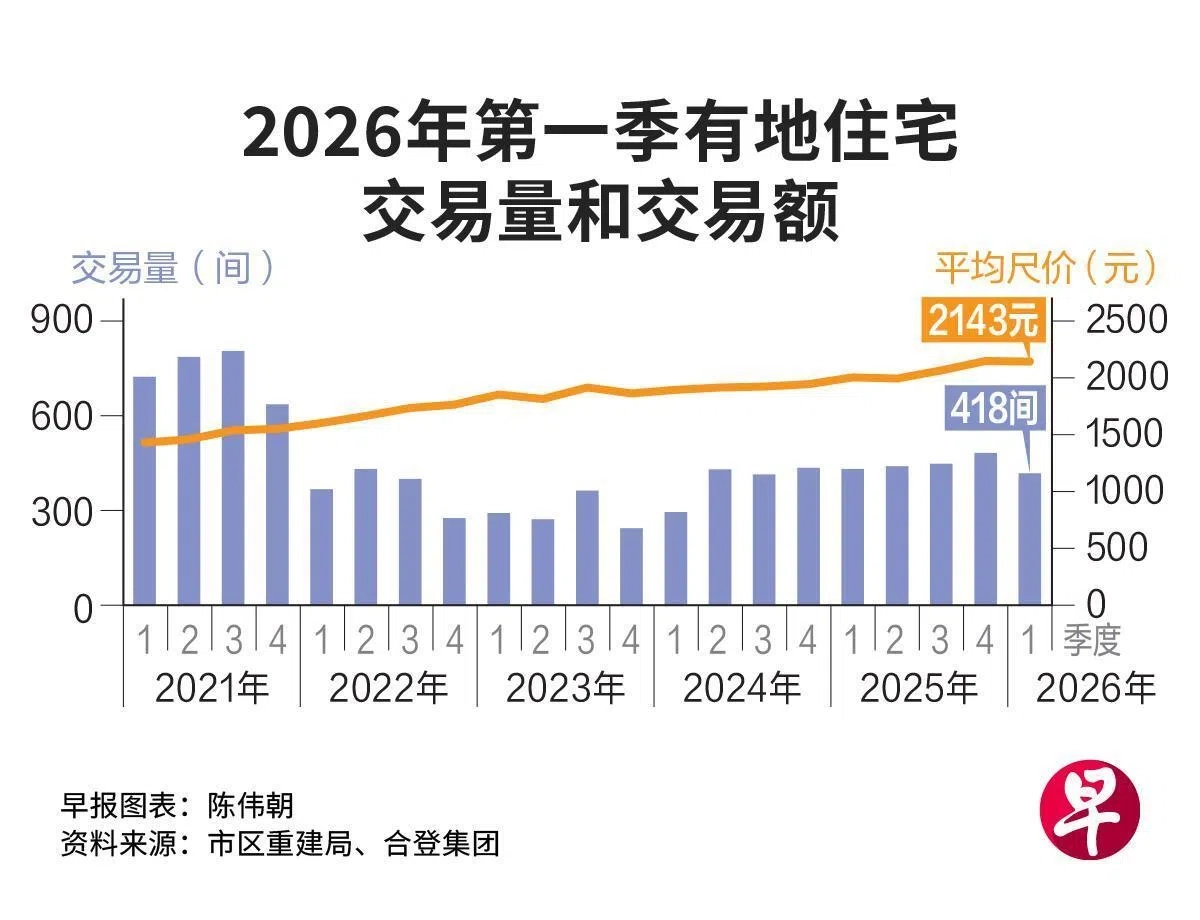
According to data, a total of 418 landed homes were sold in the first three months of the year, down 13.3% from 482 units in the previous quarter, and dipping approximately 3% year-on-year.
At the same time, total transaction value fell 3.8% quarter-on-quarter to around S$2.7 billion. However, this still represented a 7.1% year-on-year increase, indicating that the market continues to enjoy underlying support.
Transaction Volumes Dip as Market Enters Wait-and-See Phase
Market analysts pointed out that the synchronised decline in transaction volumes and total sales value was primarily driven by buyers and sellers adopting a cautious stance amidst external uncertainties.
In particular, developments in the Middle East conflict have prompted some market participants to hold off on decisions until the situation becomes clearer before making a move.
In addition, seasonal factors stemming from the Chinese New Year period also affected the pace of transactions in the first quarter to some extent.
Prices Defy Trend and Rise, Bolstered by Affluent Buyers
Despite the decrease in overall transaction volume, landed home prices bucked the trend and headed upwards.
The average price per transaction rose 10.9% quarter-on-quarter in Q1 to reach approximately S$6.5 million, reflecting ongoing support from high-net-worth buyers.
Among these, detached houses saw the most notable price gains, with average per-square-foot prices rising 15.9% quarter-on-quarter to $2,069 psf—crossing the $2,000 psf threshold for the first time.
In comparison, price movements for terraced houses and semi-detached houses remained relatively stable, hovering at $2,284 psf and $1,934 psf respectively.
Significant Price Disparities: Tenure Remains the Crucial Factor
Price disparities within the landed property segment remain substantial.
The highest transaction of the quarter was a freehold detached house on Dunearn Road, which fetched a staggering S$55 million. At the other end of the spectrum, the lowest transaction was a terraced house in Bedok with only eight years remaining on its lease, selling for just S$400,000.
This underscores once again that lease tenure remains a pivotal consideration in buyers' decision-making processes.
Data revealed that freehold and 999-year leasehold properties accounted for 88% of total transaction volumes, averaging around $2,223 psf. By contrast, 99-year leasehold homes recorded a markedly lower average price of $1,554 psf.
Macroeconomic Environment a Key Variable
Industry observers generally believe that future market trajectories will be heavily contingent upon external developments.
Should the Middle East conflict drag on or escalate, compounding increases in oil prices and construction costs, development expenses could be pushed even higher, potentially dampening buyer confidence.
Meanwhile, against inflationary pressures and elevated interest rates, higher borrowing costs could also curb some buying demand.
Shifting Buyer Behaviour: From Rebuilding to "Move-In Ready"
With construction costs poised to climb, a segment of buyers who previously considered acquiring older properties for redevelopment may shift their focus towards move-in-ready homes.
This suggests that the structure of market demand may evolve, creating divergent impacts across different landed property types.
Market Outlook: Stable Prices, Transaction Volumes May Taper Further
Looking ahead, analysts broadly anticipate that landed home prices will hold steady overall in 2026, though transaction volumes may ease further slightly.
Nevertheless, as Singapore continues to welcome new citizens and high-net-worth individuals, underlying capital inflows are expected to provide long-term resilience for the market.
Singapore's landed residential property market is transitioning into a phase of "lower volumes, stable prices". Amid heightened external uncertainties, the market's pace has moderated, but core demand remains robust. Moving forward, the market will rely more heavily on macroeconomic shifts, while placing a greater spotlight on the intrinsic value and appeal of individual properties.