News
November private home market heats up, but premature to introduce cooling measures

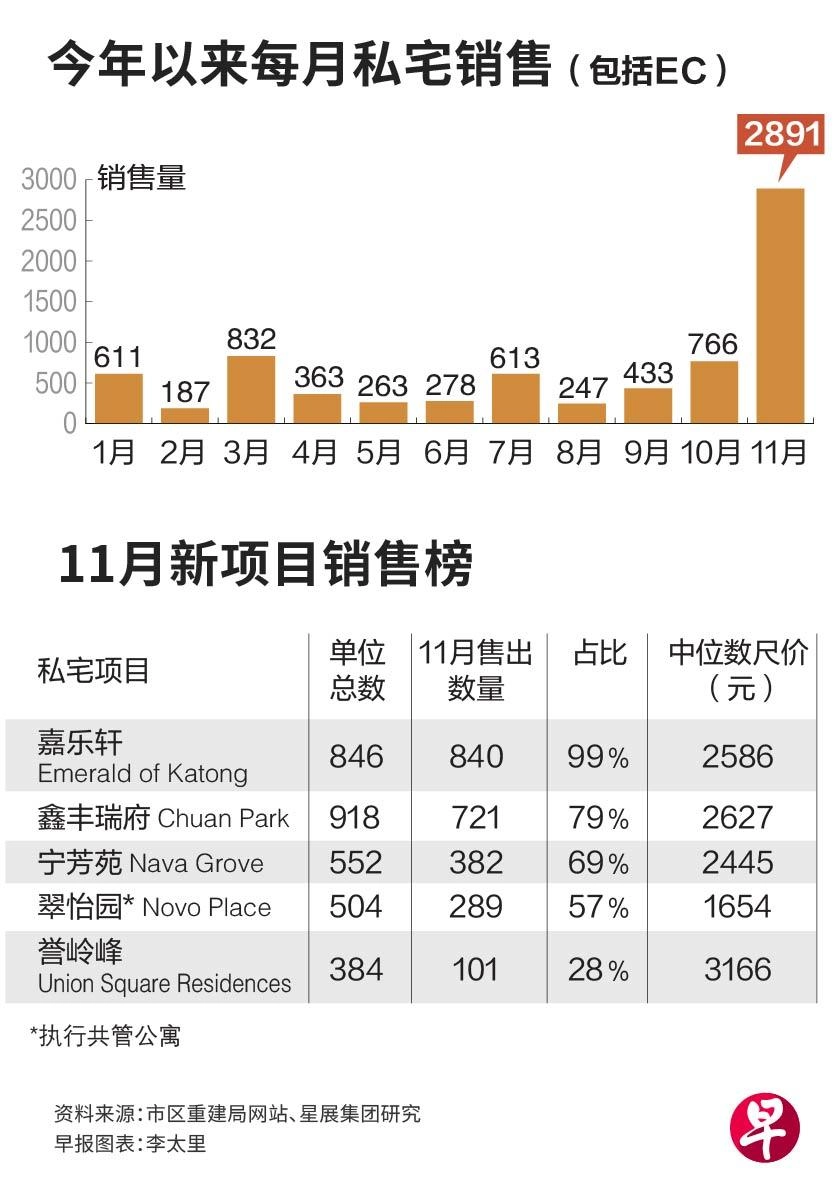
Singapore’s new private home market saw bumper sales in November, sparking discussion on whether the government might roll out another round of property cooling measures. However, DBS Group Research believes that while robust November sales have injected confidence into the market, there are no signs of a bubble forming, making cooling measures unnecessary for now.
The report pointed out that while new private home sales in November were stellar, this came on the back of a "drought" in the first 10 months of the year, where monthly sales averaged only 440 units. Full-year new private home sales for 2024 are projected to reach only 7,500 to 7,800 units, lower than the 8,000 to 9,000 units seen in previous years.
The strong sales achieved by developers in November 2024 have reignited market talk that the government could introduce new cooling measures to rein in market sentiment, but we believe this would be premature.

It also noted that existing measures have effectively stemmed the inflow of foreign "hot money" into the local property market, with virtually zero speculative foreign capital given that foreign transactions accounted for only 6% of total transactions for the year. Currently, the majority of private home buyers are Singapore Citizens or Permanent Residents, with demand largely driven by HDB upgraders. As such, there are no signs of a bubble in the local property market, and there is little need to cool it down.
According to the latest data released by the Urban Redevelopment Authority (URA) on Monday, developers launched 2,871 new private homes (excluding Executive Condominiums) and sold 2,557 units last month, surging 437.6% and 246.5% respectively compared to October.
November Sales Surge is a Transitory Phenomenon
The stellar sales figures in November were primarily driven by the launch of six major new projects. Due to a dearth of major launches earlier in the year, overall sales had been sluggish, with only 3,049 units sold in the first three quarters—the weakest first-to-third quarter performance in nearly 20 years since URA began tracking data in 2004.
The robust performance in November is unlikely to immediately trigger a fresh round of cooling measures, as the sales spike is a transitory phenomenon rather than an indication of an overheating market.
Barring a sharp surge in prices, there is no need for new cooling measures in the near term.
The government proactively manages the property market, monitoring developments closely and intervening when necessary to maintain market stability. Following the cooling measures rolled out in April last year, private home prices have also stabilised over recent quarters.
On the other hand, the government could potentially adjust the Additional Buyer’s Stamp Duty (ABSD), with speculation not ruling out a 5% ABSD on local buyers purchasing their first residential property priced above $1 million.
In response, analysts noted that first-time homebuyers are primarily driven by owner-occupier needs rather than speculation. Taxing this group would pose hurdles for young families and aspiring private homeowners, penalising genuine end-users.
Such a move would not curb local demand for private housing. With some households exceeding the income ceiling for Build-To-Order (BTO) flats or needing replacement housing after selling their flats, imposing ABSD on individuals with genuine housing needs would be unfair.