News
Government Introduces New Round of Cooling Measures: ABSD for Foreign Buyers Doubled from 30% to 60%!
The government announced a fresh round of property cooling measures late at night to promote a sustainable real estate market.
Starting today (27 April), the Additional Buyer’s Stamp Duty (ABSD) rates for residential properties will be raised by 3 to 30 percentage points. Foreign buyers will face the steepest hike, with the ABSD rate doubling from 30% to 60%.
For instance, on a private residential property valued at $2 million, the ABSD payable by a foreign buyer will surge from $600,000 to $1.2 million.
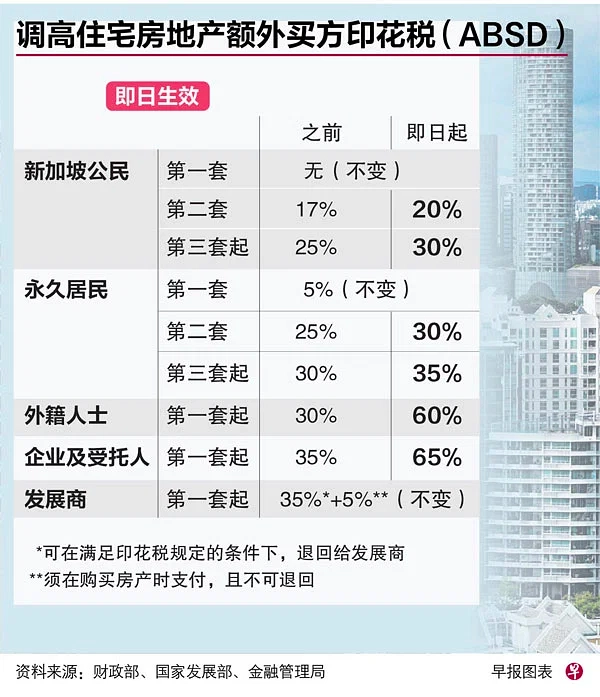
Singapore Permanent Residents (PRs) purchasing their second and third (or subsequent) residential properties will see ABSD rates increase from 25% and 30% to 30% and 35%, respectively. The ABSD rate for PRs buying their first property remains unchanged at 5%.
As for Singapore Citizens (SCs) purchasing their second and third (or subsequent) residential properties, ABSD rates will rise from 17% and 25% to 20% and 30%, respectively. Singapore Citizens buying their first property will continue to pay zero ABSD.
In addition, the ABSD rate for entities, including corporates and trusts, will be raised from 35% to 65%. However, the ABSD rate for housing developers remains at 35%, comprising a 30% remissible component subject to upfront conditions, and a 5% non-remissible component.
In a joint press release issued late Wednesday night (26 April), the Ministry of National Development (MND), Ministry of Finance (MOF), and the Monetary Authority of Singapore (MAS) stated that to promote a sustainable property market and prioritise owner-occupier housing demand, the government is further raising ABSD rates to preemptively manage investment demand.
Based on 2022 transaction data, the revised ABSD rates will affect approximately 10% of residential property transactions.
Property Price Growth Showed Signs of Acceleration Again in Q1
The press release noted that the property cooling measures introduced in December 2021 and September 2022 had a moderating effect. However, in the first quarter of this year, property price growth showed renewed signs of acceleration driven by resilient demand.
"Demand from locals purchasing homes for owner-occupation has been especially strong, alongside renewed interest from both local and foreign investors in Singapore's residential property market. Left unchecked, prices could outpace economic fundamentals, risking a sustained price increase relative to incomes," the joint statement said.
According to flash estimates released by the Urban Redevelopment Authority (URA) on 3 April, overall private residential property prices rose for the 12th consecutive quarter, climbing 3.2% quarter-on-quarter in Q1, up from a 0.4% increase in the fourth quarter of last year.
Higher ABSD Rates to Complement Ramped-Up Housing Supply
The statement highlighted that the increase in ABSD rates will complement the government's efforts to ramp up housing supply, thereby alleviating pressure on both the housing and rental markets.
Under the Government Land Sales (GLS) programme, private residential units launched via the Confirmed List were increased from 3,500 units in the second half of last year to 4,100 units in the first half of this year. In total, the government released 6,300 units last year.
On the public housing front, the Housing & Development Board (HDB) launched over 23,000 flats last year and plans to launch up to 23,000 flats this year. The authorities are on track to launch 100,000 new flats between 2021 and 2025. The statement highlighted that the government will maintain a steady supply pipeline to satisfy growing housing demand.
The three agencies noted that while the COVID-19 pandemic severely disrupted the progress of HDB and private residential projects, construction is now back on track. Between this year and 2025, close to 100,000 public and private residential units are slated for completion, with almost 40,000 units expected to be completed within this year.
The release reiterated that these measures aim to moderate housing demand, prioritise owner-occupiers, and ensure adequate housing supply. "The government will continue to adjust policies as necessary to keep them relevant and promote a sustainable property market."