Buyer's Guide · News
EC Rules Tightened Across the Board: An End to the '5-Year Windfall'? Upgraders Hit Hardest as Government Cools the Market
Major Overhaul in EC Policy: 10-Year MOP, Removal of Deferred Payment Scheme, and Higher First-Timer Quota
On 8 May, the Singapore government announced a sweeping suite of new measures for the Executive Condominium (EC) market. This marks the most significant policy tightening for the EC segment since 2013.
The key measures include: extending the Minimum Occupation Period (MOP) from 5 to 10 years, scrapping the Deferred Payment Scheme (DPS), and increasing the quota for first-time buyers from 70% to 90%.
These new regulations will apply to EC sites launched under tenders closing on or after 8 May.
The government stated that the primary objective of this move is to curb the "lottery effect", discourage short-term speculative flipping, and steer ECs back to an "owner-occupier" orientation.

MOP Officially Extended to 10 Years
The most closely watched change in the market is undoubtedly the extension of the EC Minimum Occupation Period from the existing 5 years to 10 years.
This means that future buyers of new ECs must hold and physically occupy the unit for at least 10 years before they are permitted to sell on the open market. Furthermore, during this 10-year window, buyers can only sell to Singapore Citizens and Permanent Residents (PRs).
At the same time, the timeline for full privatisation of ECs has been pushed back from 10 years to 15 years. In other words, foreign buyers will now have to wait until an EC project reaches its 15th year before they can purchase a unit.
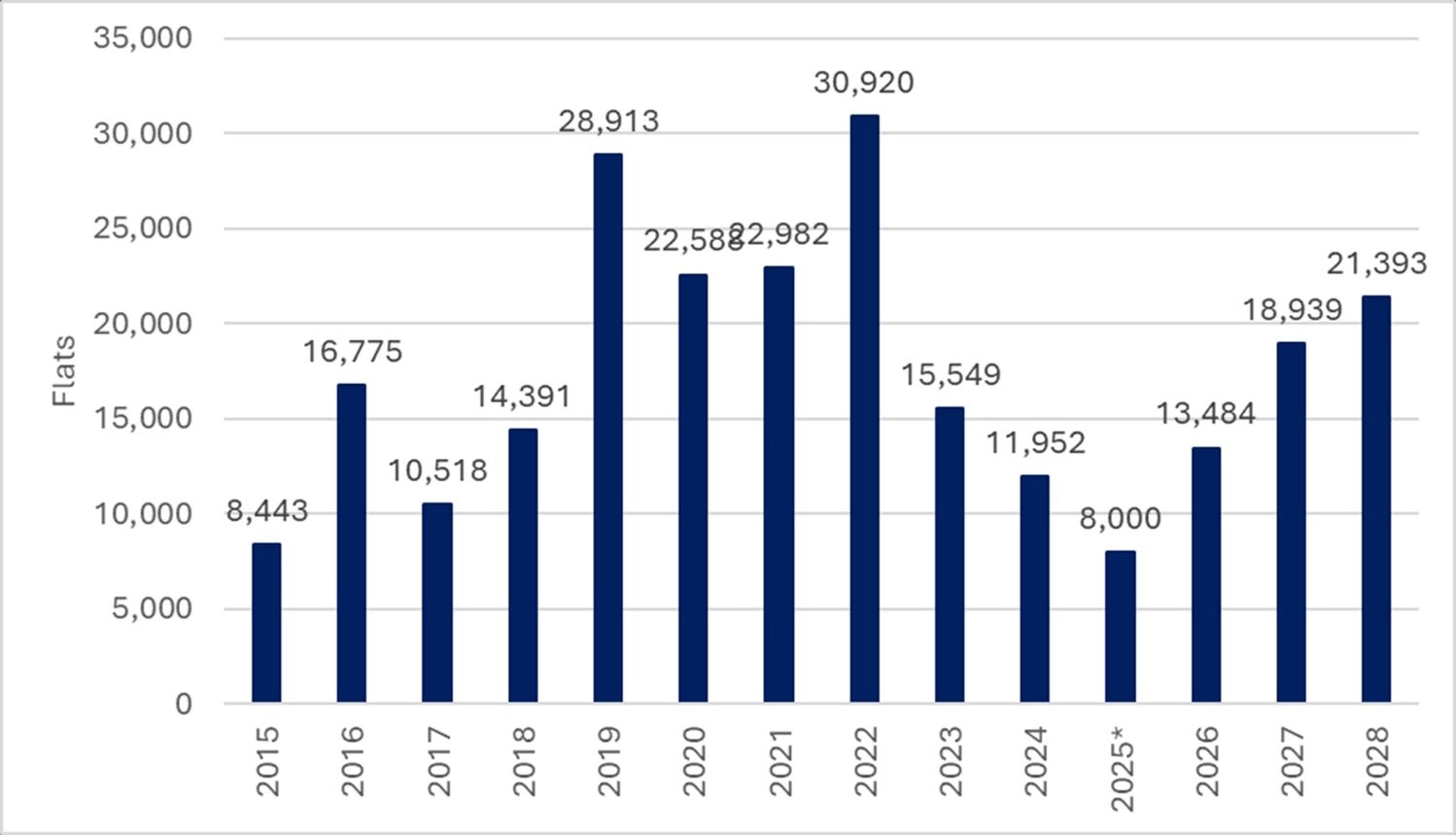
Industry observers note that this policy aligns with the rationale behind the 10-year MOP implemented for Prime and Plus HDB flats, both aimed at curbing excessive short-term windfall gains.
According to data, between 2021 and 2025, approximately 75% of EC resale transactions occurred shortly after hitting their 5-year MOP, sharply up from 45% recorded in the preceding five years.
An increasing number of EC owners have walked away with gross profits exceeding S$1 million upon resale. In 2025 alone, 162 "million-dollar profit" EC transactions were registered, with an average holding period of around 9.6 years.
Among these, the highest recorded gain came from The Tampines Trilliant, where a 4-bedroom unit was sold in April 2026, reaping a profit of over S$2 million.
How Fast Have EC Prices Surged Over the Years?
Data reveals that EC prices have climbed at a staggering pace over the past decade.

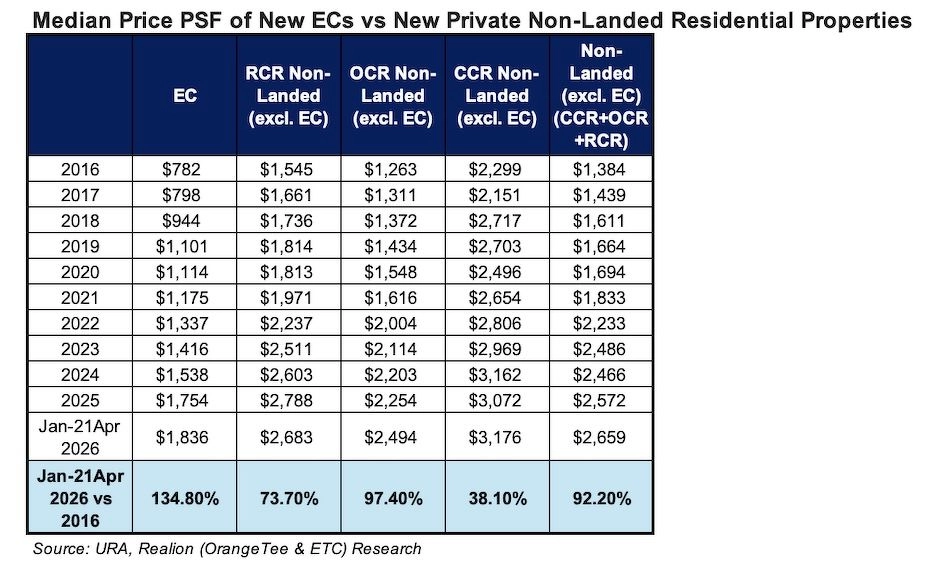
According to URA data, median prices for new ECs surged from $782 psf in 2016 to $1,836 psf in the first four months of 2026, representing an eye-watering increase of 134.8%.
In comparison, new non-landed private residential homes rose by about 92.2% over the same period, noticeably lagging behind ECs.
In fact, across the RCR, OCR, and CCR, the capital appreciation of ECs has outpaced the broader private residential market. This runaway growth is one of the key catalysts prompting the authorities to step in.
Under the New Policy, Which ECs Could Benefit the Most?
Because the new regulations only apply to EC sites with tenders closing after 8 May, EC parcels that have already been awarded stand to benefit. These include sites at Senja Close, Woodlands Drive 17, Sembawang Road, and Miltonia Close. These upcoming EC launches, expected to hit the market around 2027, will still be governed by the legacy rules—namely, a 5-year MOP.

Market watchers believe these "last of the 5-year MOP ECs" could see their appeal rise significantly.
A similar dynamic unfolded following the introduction of the Prime and Plus HDB models, where buyers gravitated toward standard HDB flats that were exempt from the new restrictions and subject only to a 5-year MOP.
Consequently, in the near term, these legacy ECs could see firmer price support.
Some Buyers May Pivot to the Private Housing Market
With the MOP lengthened to 10 years, some prospective buyers may reconsider whether an EC remains the right choice.
By contrast, while private properties are subject to Seller's Stamp Duty (SSD), the holding restriction lasts only 4 years, offering far greater flexibility. Hence, analysts anticipate that some buyers previously eyeing ECs may now divert their attention to new private launches, resale private condos, or resale ECs.
For investment-minded buyers in particular, a 10-year lock-in period significantly diminishes the appeal of ECs for short- to medium-term capital gains.
Nonetheless, some analysts point out that even with an extended MOP, new ECs still offer a 20% to 30% discount compared to surrounding private condominiums. With long-term capital appreciation potential remaining intact, genuine owner-occupiers are likely to stay engaged.
Scrapping DPS Hits HDB Upgraders the Hardest
Another major shift is the official removal of the Deferred Payment Scheme (DPS). Historically, over 75% of EC buyers opted for DPS, particularly second-timers.
The greatest advantage of DPS was that buyers could defer loan repayments on the new EC until their existing HDB flat was sold, substantially easing their cash flow burden.
With DPS abolished, many HDB upgraders will now have to service two housing loans simultaneously during the construction phase. This raises the financial bar for upgrading, ratchets up cash flow pressure, and curbs the purchasing capacity of some buyers.
Industry experts believe this will directly dampen the enthusiasm of certain HDB upgraders from entering the market.
Moreover, EC purchases are subject to the Mortgage Servicing Ratio (MSR) cap of 30% of monthly household income. With the MOP now stretched to 10 years, buyers will remain constrained under these terms for a prolonged period.
Compared to the 55% Total Debt Servicing Ratio (TDSR) applied to private properties, financing rules for ECs are distinctly more stringent. This suggests that buyers will exercise greater caution when committing to an EC moving forward.
First-Timer Quota Raised to 90%
The latest policy also heavily tilts the playing field in favour of first-time homebuyers. Moving forward, 90% of units in new EC launches will be reserved for first-timers.
Second-Timer Quota Cut from 30% to 10%
In addition, while the second round of balloting for second-timers previously opened after one month, it will now only take place two years after launch. This grants first-time buyers an extensive runway to select units at their own pace.
Second-Timers Face Tougher Competition for Choice EC Projects
This shift will notably alleviate balloting pressure for first-timers in highly sought-after EC developments—particularly those close to MRT stations, reputable schools, and mature estates, where competition among second-timers has historically been fierce.
Why Was Second-Timer Demand So Strong?
In reality, the robust EC sales witnessed over the past few years were largely propelled by HDB upgraders.
In the first quarter of 2026 alone, Coastal Cabana moved 593 units, while Rivelle Tampines sold 530 units (representing 92.7% of its total inventory). Rivelle Tampines was snapped up almost entirely during its second-timer balloting phase.
At the same time, EC benchmark prices continued to break new ground.

Aurelle of Tampines achieved a record median price of $2,052 psf, setting a new historical high.
Market statistics show that EC sales reached 1,168 units in 1Q 2026, reflecting exceptionally robust demand.
What Lies Ahead for the EC Market?
Market consensus suggests that the new framework will fundamentally alter the structural dynamics of the EC market.
Several trends are expected to emerge: a slower sales velocity for new EC launches, more conservative land bidding from developers, stabilisation of EC land prices, an outflow of demand towards private properties, and a potential increase in resale HDB flat supply.
Analysts project that future EC land tender bids could soften by up to 10%, as developers step back from aggressive land-banking. This also points to a likely moderation in future EC price growth.
On the flip side, for families seeking a home purely for their own occupation, ECs will retain substantial appeal.
Given that private home prices remain elevated, ECs continue to offer the most viable, realistic gateway for middle-income households to step into private housing.
Summary: The EC Enters the "Long-Term Owner-Occupier Era"
On balance, the direction of this EC policy shift is crystal clear: curtail short-term capital arbitrage, dampen the "lottery effect", prioritise first-time homebuyers, and reinforce the primary function of housing as a home.
Over the past few years, ECs have increasingly evolved from "affordable private housing" into "high-yield asset plays". Today, the government is firmly steering ECs back to their core purpose as owner-occupied homes. For prospective buyers, future EC purchases will demand a mindset shift—away from the five-year flipping playbook towards genuine long-term living and sound financial planning.