News
Dwindling Inventory, Scarce Land: How Developers Replenishing Landbanks Impacts Land Prices
With En Bloc Sales Dwindling, Why Has the GLS Programme Become a Crucial Choice for Developers?
Why are property developers willing to pay a premium for land during certain periods?
Beyond future selling price expectations, another critical factor worth watching is the level of unsold residential stock remaining in the market.
As existing projects progressively sell out, developers must replenish their land banks. When alternative land sources dry up, the Government Land Sales (GLS) programme naturally becomes an even more critical channel.
Unsold Inventory and Land Prices Often Move in Opposite Directions
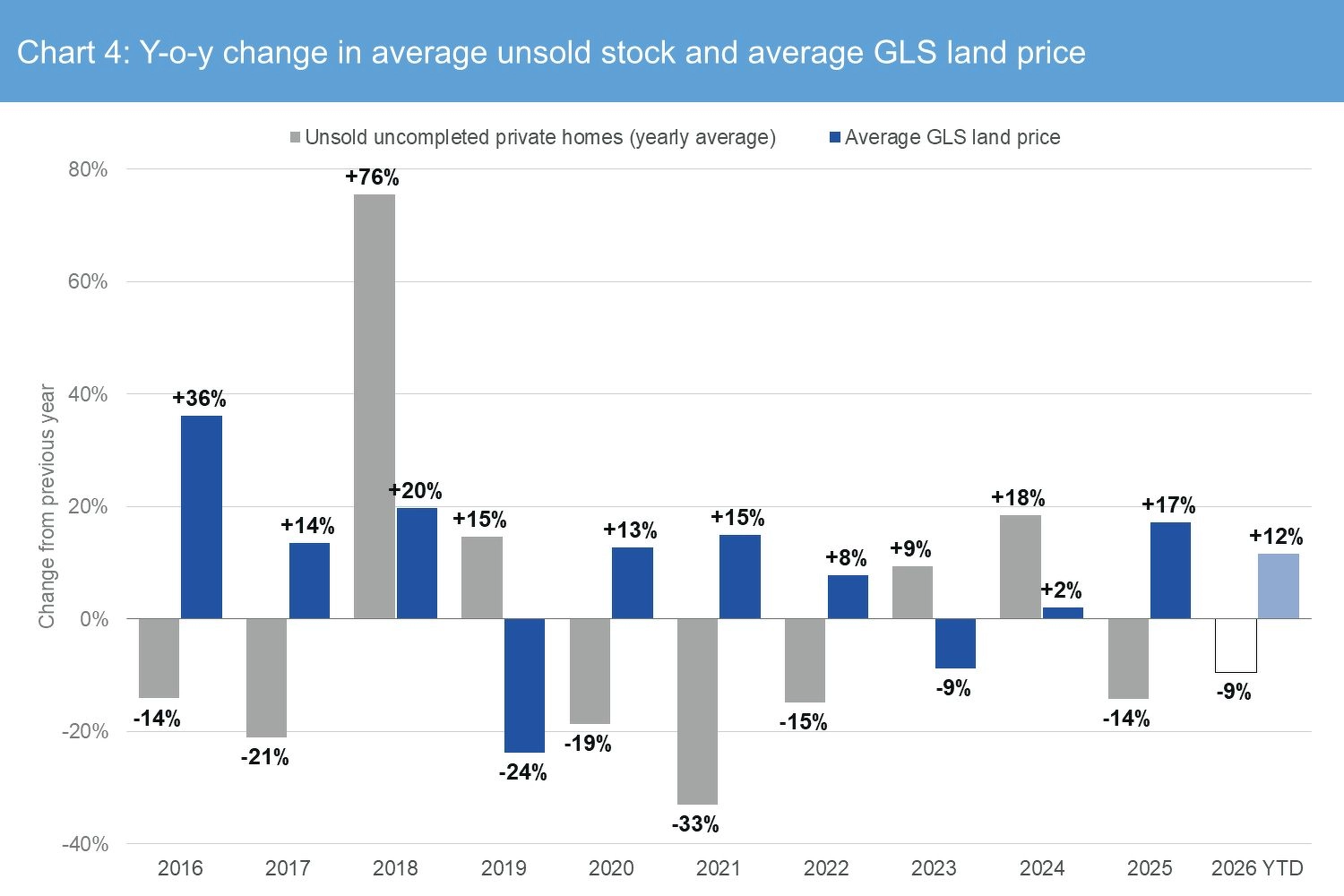
Analysis shows that in eight of the ten years between 2016 and 2025, unsold inventory and land prices moved in contrasting directions.
After comparing individual sites and adjusting for regional price differentials, the analysis revealed that for every 10% decrease in unsold inventory in the year prior to tender closing, the winning bid was on average 4% to 5% higher.
While this reflects a statistical correlation rather than direct causation, a dip in inventory does not automatically trigger an equivalent rise in land prices.
Nonetheless, it offers a plausible explanation: falling unsold inventory not only points to healthy home sales, but also drives greater motivation among developers to replenish their land banks.
Rising Inventory Can Simply Mean More Project Approvals
Unsold inventory figures do not merely comprise launched but unsold units.
The Urban Redevelopment Authority (URA) factors units into unsold supply once a development secures planning approval, even before its official launch.
In 2018, unsold inventory surged by around 76%, partly because sites acquired during the 2017 collective sale (en bloc) fever gradually received planning permission.
Therefore, an increase in inventory does not necessarily signify lacklustre sales; it may simply reflect future supply advancing through the planning pipeline.
Collective Sales Tapered Off Sharply After the En Bloc Wave
Collective sales were once a pivotal avenue for developers to acquire residential land.
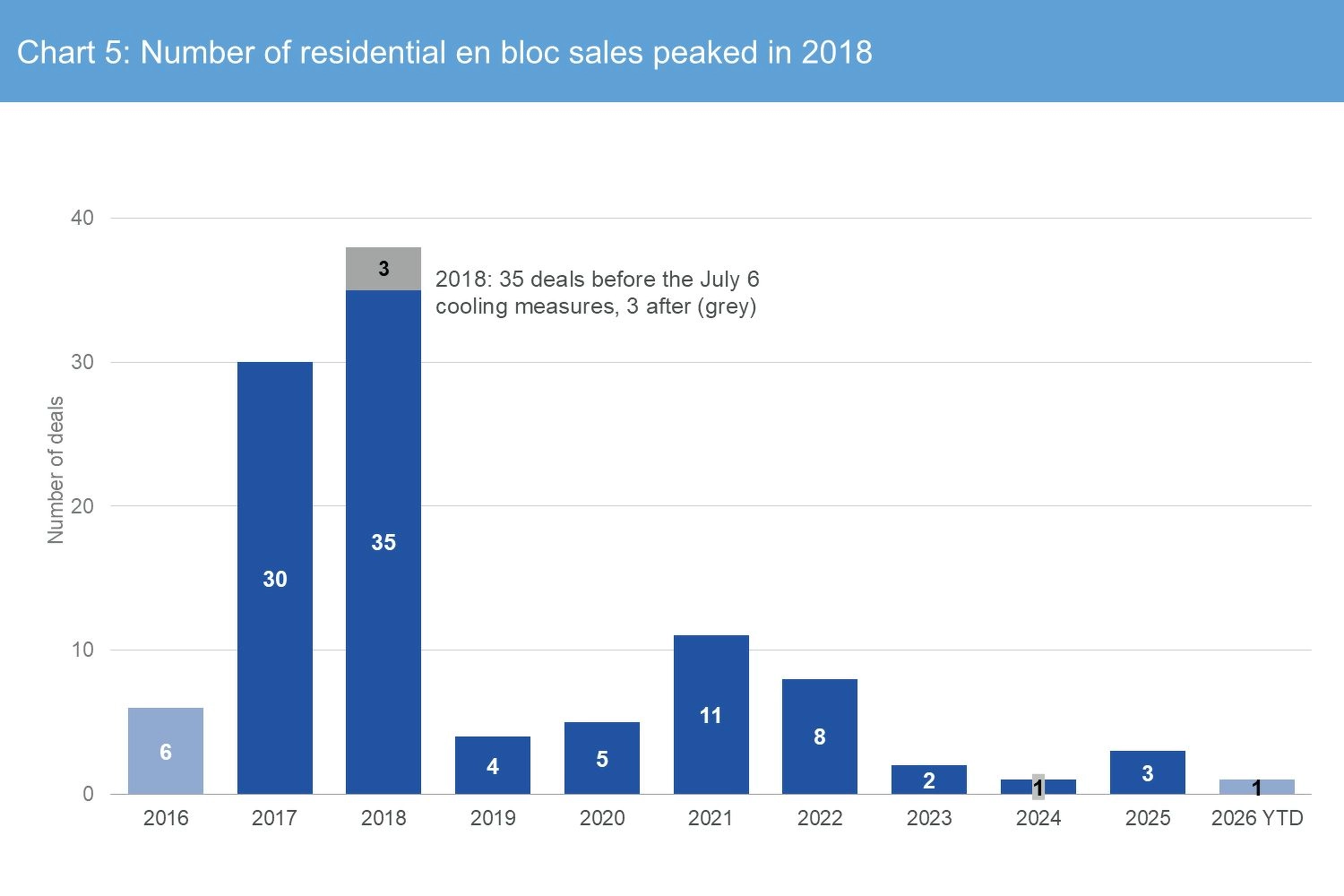
In 2018, residential collective sale transactions reached 38 deals, 35 of which were concluded before the property cooling measures took effect on 6 July that year.
At the time, the Additional Buyer's Stamp Duty (ABSD) for housing developers was raised from 15% to 30%, payable upfront. Of this, 25 percentage points could be remitted subject to fulfilling conditions, such as completing the project and selling all units within five years.
In 2019, en bloc transactions plummeted to four deals. They rebounded to 11 in 2021, but dwindled again to just two in 2023.
In December 2021, developers' ABSD was further hiked to 40%, with 35 percentage points remittable under specific conditions.
En Bloc Developments Face More Intricate Timelines
Both GLS and collective sale sites are subject to stringent project development and sales deadlines.
However, en bloc projects typically require waiting for existing owners to vacate before demolition and redevelopment can commence, making early-stage logistics far more complex.
For developers, this heightens execution pressure to complete construction and sell all units within the stipulated timeframe. As en bloc opportunities wane, the GLS programme becomes increasingly vital for land replenishment.
GLS Contribution to Land Supply Has Surged Significantly
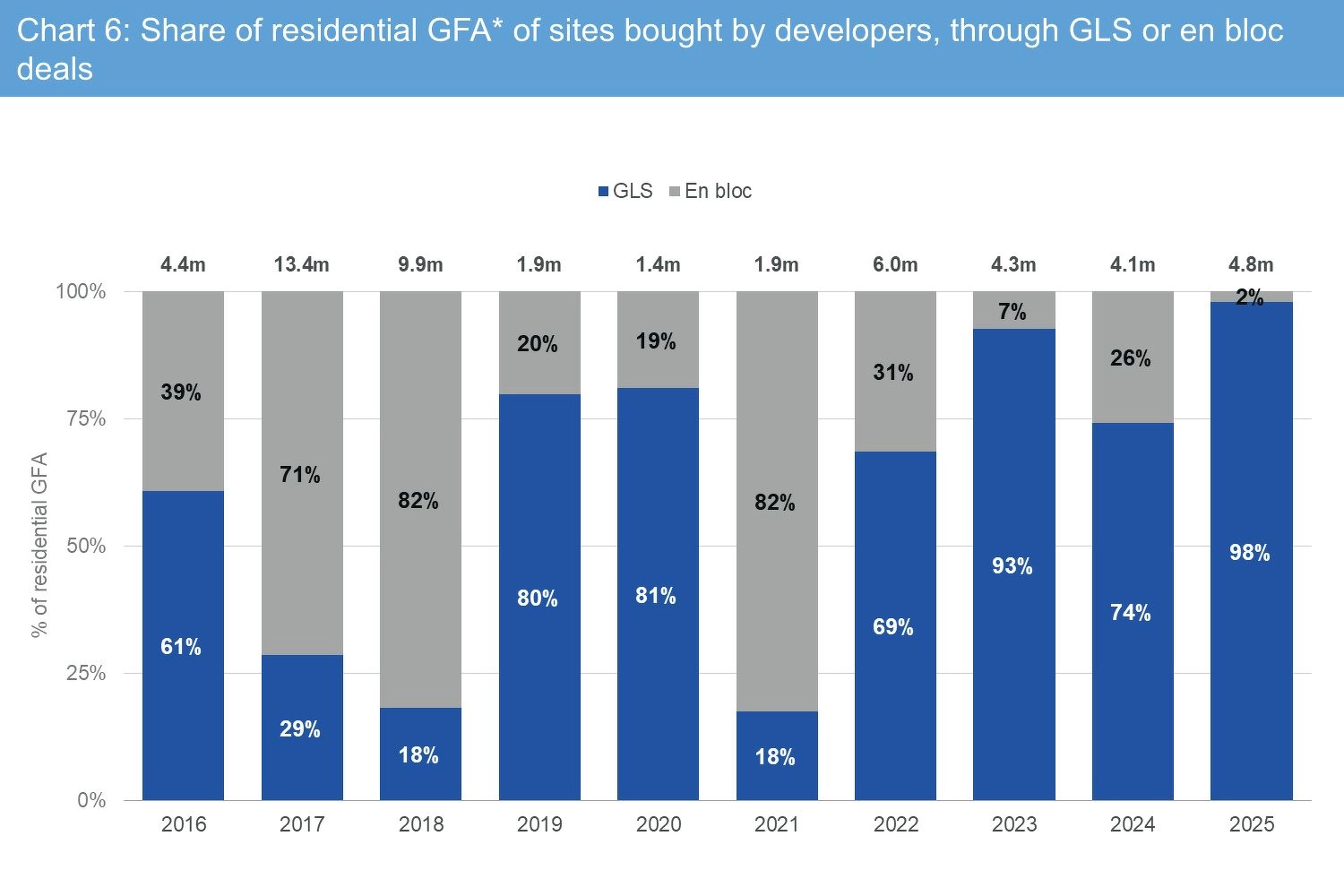
Among the residential gross floor area (GFA) acquired by developers via GLS and collective sales, the share from GLS surged from less than 30% in 2017 and 2018 to at least 69% annually since 2022.
Although the government ramped up land supply from 2022 onwards, average land rates have remained resilient and climbed again in 2025.
Year-to-date at the time of reporting, average unsold stock fell by approximately 9%, while the average residential GLS land rate rose to S$1,465 per square foot per plot ratio (psf ppr).
However, a higher proportion of GFA awarded this year came from the Rest of Central Region (RCR) and Core Central Region (CCR), which also elevated the overall average.
Shifts in land prices are ultimately the interplay of inventory levels, land sourcing channels, site location, and pricing expectations. Looking at an individual tender price in isolation may not tell the whole market story.
The ABSD rates in this article are stated based on historical periods referenced in the text; the correlation between unsold inventory and land prices is statistical and does not imply absolute causation.