News
APAC Investment Set for Full Recovery in 2025, Singapore Market to Move in Tandem with Global Markets

Savills Research noted in its Global Outlook 2025 report released on 28 November that the Asia-Pacific (APAC) real estate market continues to outperform its global peers, with real GDP growth outpacing both the US and Europe.
Savills stated: For the first time in five years, the economic outlook appears more stable and perhaps more convincing. This will allow the market to regain its footing, bolstering investment and activity.
In the first nine months of 2024, APAC investment volumes rose 4% year-on-year to US$108.7 billion. The three markets recording the most significant y-o-y growth in investment volume during this period were Singapore (up 74%), South Korea (71%), and Australia (63%).
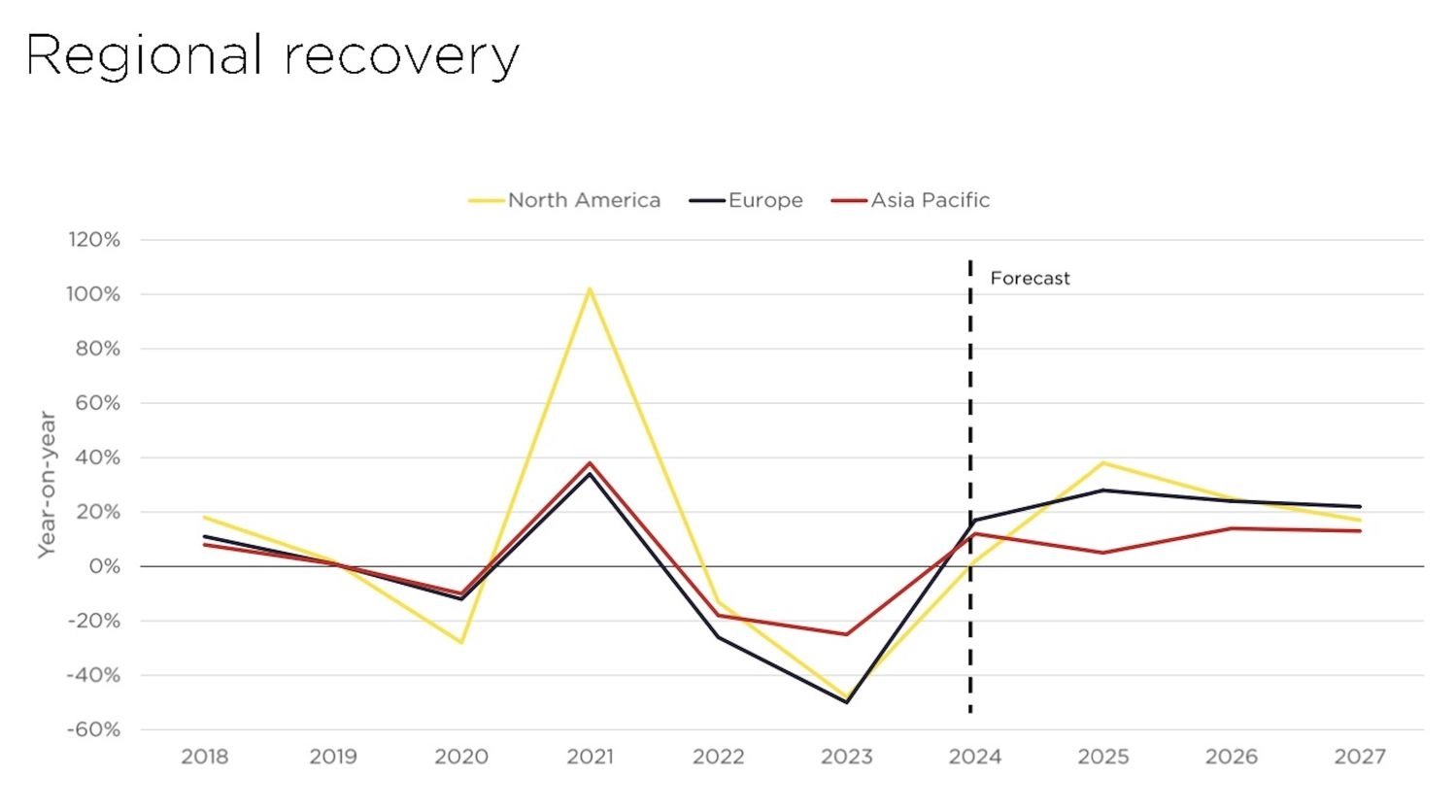
Savills Research projects that global real estate investment transaction volumes will expand by 27% to US$952 billion in 2025. By 2026, global investment activity is expected to surpass the US$1 trillion mark for the first time since 2022.
Savills noted that, buoyed by stabilising interest rates and improving investor confidence, global investment is anticipated to return to pre-pandemic levels by 2026.

Furthermore, Singapore's property market is expected to move in tandem with global markets.
Meanwhile, Savills highlighted that APAC is poised for a "broad-based investment recovery" next year, driven by sectors such as hospitality, living, and industrial—particularly logistics and data centres.
The conditions are in place for a revival in real estate investment appetite across APAC next year, while long-term structural trends should underpin capital values in growth markets such as India and Southeast Asia.
Savills added that the APAC office sector remains compelling, accounting for 37% of the region's total real estate investment in the first three quarters of 2024, markedly higher than the global average of 23%.
Singapore, China, South Korea, and Japan boast the highest office utilisation rates in the region, with occupancy rates topping 90%. APAC also remains a stronghold for green-certified office spaces, as occupiers place greater emphasis on environmental, social, and governance (ESG) criteria.
In Singapore, office tenants are placing increasing emphasis on the green agenda. Activity levels have also picked up slightly, with more leasing deals concluded.
From 2025 to 2026, CBD Grade-A office rents are expected to hold steady.
As a regional hub and gateway, Singapore remains a favoured destination for new overseas brands. Prime retail developments continue to see healthy demand, keeping rental levels resilient.
In the industrial segment, despite cost pressures, demand across key sectors such as logistics, advanced manufacturing, healthcare, and data centres remains robust, which will help stabilise rental rates and capital values over the long run.
The widespread adoption of artificial intelligence has led to the development of more data centres in Singapore. More data centre service providers are also using the city-state as a springboard while sourcing locations to build infrastructure.
As global investment and activity return to more sustained growth, the real estate industry must navigate evolving legislative landscapes and geopolitical dynamics, while delivering sustainable and socially responsible development to meet the needs of a changing world.